Record Family Timeline
From the first Record derailleur to the aerodynamic C-Record redesign.
1958–1966
Record — Early aluminium hubs, cranksets and the chromed-bronze rear derailleur that began the dynasty.
1967–1987
Nuovo Record — Lighter aluminium rear derailleur, 144 mm BCD crank, the workhorse of the professional peloton. Merckx’s early Tour wins rode on it.
1973–1987
Super Record — The icon. Titanium bolts and axles, refined finishes, the polished aluminium that still defines “Campy” for most collectors.
1985–1986
Delta brakes introduced — the radical parallelogram centre-pull design that became both legend and controversy.
1986–early 1990s
C-Record (Corsa Record) — Full aerodynamic redesign that replaced Super Record at the top of the range. Smooth shapes, Delta (then later dual-pivot) brakes.
1992 onward
ErgoPower — Combined brake/shift levers answering Shimano STI. The mechanical era of pure downtube or bar-end shifting begins to close.
Three Great Groups
≈ 1967 – 1987
Nuovo Record
The long-running backbone of Campagnolo’s catalogue. Aluminium rear
derailleur (replacing the earlier bronze Record), 144 mm BCD crank
that allowed smaller inner rings, and a complete group that could
be mixed with Super Record pieces.
- Rear derailleur: Aluminium, date-coded patents
- Crank: 144 BCD, typically 52/42 or similar
- Character: Indestructible, elegant workhorse
- On steel: Extremely common on 70s–early 80s frames
1973 – 1987
Super Record
The group that still stops conversations. Titanium hardware,
refined machining, the famous polished finish. Many “Super Record”
bikes actually mixed Super Record and Nuovo Record parts (especially
bottom brackets and pedals).
- Signature: Titanium bolts & BB axle options
- Crank / pedals: Super Record or Superleggeri
- Character: Lighter, more precious, pure race
- On steel: The dream group for Colnago, De Rosa, Cinelli
1986 – early ’90s
C-Record
Campagnolo’s answer to the aero and indexed-shifting revolution.
Completely restyled components, the controversial (and beautiful)
Delta brakes, and a more modern silhouette while keeping the
Vicenza quality.
- Signature: Delta brakes, aero crank arms
- Look: Rounded, smooth, 1980s futurism
- Character: Transitional — still highly collectible
- On steel: Perfect on late-80s Italian frames
Nuovo Record Mechanical Details
The longest-lived and most widely used Record-family group. Produced roughly
1967–1987, it is the mechanical backbone of countless Italian and French steel racers.
Nuovo Record (“New Record”) replaced the earlier chromed-bronze Record rear
derailleur with a lighter aluminium design while keeping the proven parallelogram
geometry. The group was sold as a complete system but was frequently mixed with
Super Record pieces in the real world — a period-correct practice.
Rear Derailleur — Model 1020/A
Design
Classic parallelogram with aluminium body. Short-cage road version was standard.
Typical max sprocket around 26–28T by folklore; total capacity modest by modern standards.
Friction shifting only — no indexing.
Patent dating (key to year)
1967–68: “PATENT CAMPAGNOLO”
1968–69: “PATENT” only
1970–79: “PATENT-70” … “PATENT-79”
1980–84: “PAT.80” … “PAT.84”
1985: “PAT.11” (special marking)
1986–87: often unmarked
Mechanical evolution
Early units used solid pivot bolts; later ones (especially 1980s) moved to
hollow rivets / roll pins. Pulley cages, spring mounts and cable-anchor details
also changed. 1978+ often have CPSC-mandated adjuster covers.
Weight & notes
Typical weight ~200–210 g. Extremely robust when kept clean and greased.
The same basic parallelogram geometry underpinned Super Record (which mainly
added titanium hardware and restyled plates).
Pivot bolts compared (lower / B-pivot)
The lower pivot bolt is one of the clearest mechanical differences across Nuovo Record production.
| Era |
Lower pivot bolt |
Friction washer |
Interchange notes |
| 1967 – 1971 |
Single-piece chromed steel; larger cylindrical section near the head |
None (not used / will not fit) |
Early bolt design. Does not need or accept the later plastic friction washer. |
| 1972 onward |
Revised chromed steel bolt; reduced diameter near the head to seat a washer |
Plastic friction washer introduced (~1972–73) |
Post-1971 bolts must be used with the plastic washer — even in an earlier body. |
| Super Record |
Same geometry family, but often titanium pivot bolts |
Same plastic washer system when using the later profile |
Ti bolts fit Nuovo Record bodies with the correct washer. Non-magnetic, slightly brownish colour. |
Parallelogram pivot pins
Early: solid aluminium pins through brass bushings, peened at both ends.
Later: hollow chromed tubes, also peened. The two styles are broadly
interchangeable if original-spec replacements can be found.
Return spring & late changes
Until ~1985 the parallelogram return spring was removable.
1985–87 variants often have a fixed spring and hollow rivets.
Solid rivets were typical through the 1970s; hollow rivets become common in the early 1980s.
Practical tip for restorers
Match the lower pivot bolt to its era (or use a later bolt + plastic washer).
Mixing an early thick-shoulder bolt with a later washer (or vice versa)
gives incorrect stack height and vague shifting feel.
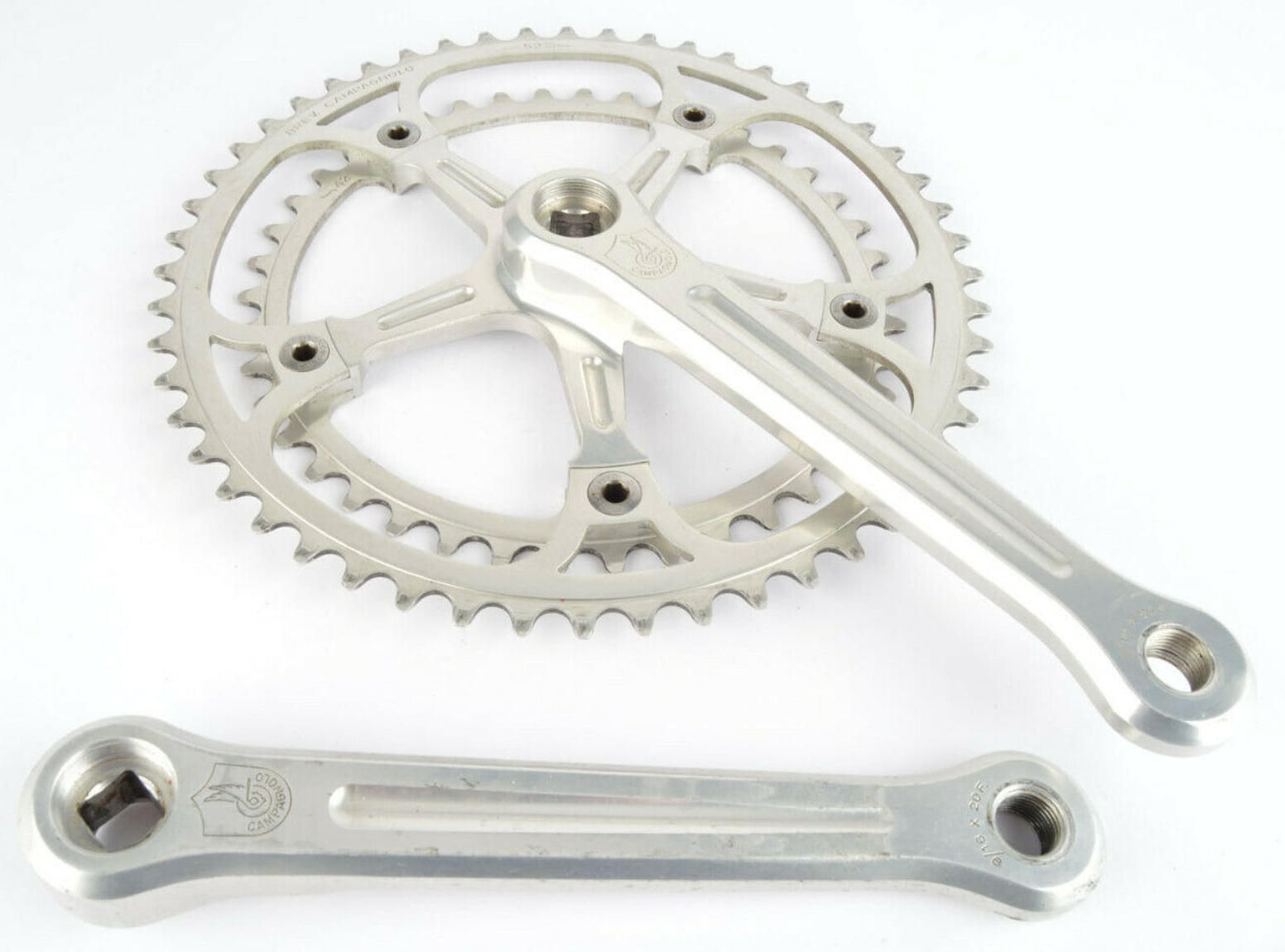
Crankset — Model 1049 (Strada)
Key specs
BCD: 144 mm (the long-lived Campagnolo standard)
Interface: Square taper
Arm lengths: Commonly 165–175 mm
Typical rings: 52/42, 52/41, 53/42, etc.
Pedal threads: 9/16″ × 20
Dating the arms
Pre-1973: often undated on the back.
1973–79: year digit inside a diamond
1980–84: year digit inside a circle
1985: “11” in rectangle · 1986: “22” · 1987: “33”
Bottom-bracket axles (critical)
Pre-1978: shorter axles (e.g. ~112 mm for 68 mm shell English)
1978 onward: longer axles (+1 / +1.5 markings) to clear the
revised front-derailleur lip required by CPSC rules. Mismatched axle + crank
era causes chainline and clearance problems.
Practical tip
Always match crank era to bottom-bracket axle length. Italian (70 mm) and
English (68 mm) shells use different axle codes (SS = strada/road).
Super Record titanium axles existed but early ones were prone to failure.
Other Core Components
| Component |
Typical details |
Notes for restorers |
| Front derailleur |
Clamp-on or braze-on; capacity suited to double road rings |
Later versions gained holes / revised cages; 1978+ lip for CPSC |
| Downtube shifters |
Friction levers (#1014 and related); clamp or braze-on bosses |
Simple, reliable, infinitely adjustable — the classic feel |
| Brake calipers |
Single-pivot side-pull; short and standard reach options |
1978+ changes to adjuster, QR and logo style; excellent when set up |
| Brake levers |
Non-aero; metal or later plastic bodies; various hood styles |
Logo placement and cable entry evolved; hoods often replaced |
| Hubs |
High or low flange; Record logo; QR skewers |
From ~1974 “RECORD” added; QR levers went from straight to curved (~1978) |
| Headset |
Threaded 1″; beautifully machined cups and races |
English or Italian thread; keep well greased |
| Seatpost |
One- or two-bolt designs; common diameters 27.0 / 27.2 mm |
Simple and elegant; binder bolt often Record-branded |
| Pedals |
Quill platform; Record / Superleggeri / Super Record variants |
Steel or titanium axles; toe-clip and strap era |
Typical Complete Group (road)
A period Nuovo Record road group usually included:
- Crankset 1049 + matching bottom bracket
- Front & rear derailleurs (1020/A rear)
- Downtube friction shifters
- Brake calipers + levers
- Hubs (front/rear) with quick-releases
- Headset, seatpost, pedals
Freewheels were separate (often Regina, Atom or later freehub conversions).
Chains and freewheels of the era were 5- or 6-speed, later 7-speed compatible
with care. Mixing Super Record titanium bolts, a Super Record rear derailleur,
or Superleggeri pedals onto a Nuovo Record base was common and still looks correct.
“The Nuovo Record rear derailleur is one of the most successful mechanical
designs ever put on a bicycle. Twenty years of continuous production, millions
of kilometres, and it still shifts with a clean, positive friction feel that
many riders prefer to modern indexed systems on a classic steel frame.”
— Why Nuovo Record remains the restorer’s friend
Super Record in Detail
The components that still define the look of a classic Italian steel race bike.
The Polished Heart
Super Record was introduced in 1973 as the top-tier evolution of
the Record family. It kept the proven geometry of Nuovo Record while
substituting lighter materials and higher finish where it mattered.
Titanium appeared in bolts, bottom-bracket axles and later pedal axles.
The aluminium was polished to a mirror that, when clean, still looks
modern fifty years later. Many complete “Super Record” groups on the
road were actually mixed — a common and period-correct practice.
Rear Derailleur
Parallelagram design refined over the Nuovo Record. Short-cage versions
dominated road racing. Patent dates stamped on the body help with dating
(PATENT-77, PAT 80, etc.).
Crankset
144 mm BCD (the standard that ruled for decades). Typically drilled
chainrings, elegant five-arm spider. Square-taper interface with
titanium or steel axle options.
Brakes
Single-pivot side-pull calipers of outstanding finish. Reach options
covered most road frames of the era. Still highly regarded for
modulation and power when properly set up.
Hubs & Bottom Bracket
Record / Super Record hubs with high or low flanges. Bottom brackets
available with steel or (more fragile early) titanium axles.
Italian or English threading.
Pedals
Super Record (titanium axle) and Superleggeri / SL (steel axle, lighter
cage). Quill pedals with toe-clip compatibility — the standard before
clipless took over.
Headset & Seatpost
Beautiful machined headsets and seatposts that completed the group.
The attention to detail on even the “small” parts is part of why
these groups still command respect.
Identifying Super Record Variants
Super Record was never a single static group. Over 1973–1987 it evolved,
and many “Super Record” bikes mixed true SR parts with Nuovo Record or
Superleggeri pieces. Here’s how to tell the main variants apart.
Generational overview (1973–1987)
| Phase |
Approx. years |
Key markers |
| Introduction |
1973–1974 |
First Super Record road & track groups; Ti BB axle, Ti pedal axles, Ti derailleur bolts, black-anodised pivots, alloy headset, drilled levers |
| Early / 1st-gen RD |
~1974 – ~1979 |
RD essentially Nuovo Record + Ti bolts + black pivots; cast logo; removable parallelogram spring bolt |
| Mid-period revisions |
1978–1982 |
Revised RD cage (better large-cog capacity); CPSC changes elsewhere; temporary Al pivot bolts 1978–79 (Ti shortage); black FD arm ~1979; Ti BB Type 2 (nuts) after early failures |
| 2nd-gen RD & Anniversary |
~1982 – 1985 |
Redesigned cage & top-pivot travel; silk-screened name; 50th Anniversary (1983) numbered/gold special; later non-removable spring |
| Late / final |
1985 – 1987 |
Non-fluted crank arms (Anniversary-derived); triangular-section brakes; last dated RDs ~PAT.11 / undated; production ends as C-Record takes over |
1. Rear derailleur (model 4001) — two main generations
1st generation (~1974 – ~1979)
Geometrically a Nuovo Record with titanium pivot bolts and black-anodised
knuckles/pivots. Logo typically cast into the arm. Parallelogram return
spring held by a removable bolt (rebuildable). Early examples may show
PATENT-7x stamps.
2nd generation (~1982 – 1987)
Redesigned cage for better shifting on larger cogs; top pivot allows more
forward swing (better chain wrap on small cogs). “Campagnolo” name
silk-screened rather than cast. Later units have a non-removable spring.
Some matte-finish variants exist. Undated on many final-year pieces.
What always marks Super Record
Titanium pivot bolts (non-magnetic, slightly brownish)
are the surest identifier versus Nuovo Record. Note: 1978–79 saw temporary
aluminium pivot bolts during a titanium shortage — still Super Record if
other cues match.
Dating the RD
Same patent system as Nuovo Record (PATENT-7x / PAT.8x). Last common
dated Super Record derailleurs around mid-1980s (e.g. PAT.11 era);
1986–87 often unmarked.
2. Bottom bracket — two titanium generations
| Type |
Period |
Axle design |
How to identify |
Notes |
| Type 1 (early) |
~1973 – early 1980s |
Hollow titanium, bolts secure the cranks |
Hollow ends; bolts into threaded axle |
Prone to breakage at the crank interface (famous Fignon 1982 Giro incident). Rare and fragile. |
| Type 2 (later) |
~1982 – mid 1980s |
Solid titanium, nuts on threaded studs |
Solid ends; nuts instead of bolts |
Redesigned for strength. Still uses 3/16″ balls and aluminium cups with steel races. |
| “Eco” / common build |
Throughout |
Steel Nuovo Record axle (1046/A) |
Silver steel axle, not brown titanium |
Most real-world “Super Record” bikes used the steel BB for reliability and cost. |
True titanium Super Record axles have a brownish colour and are non-magnetic.
Steel Nuovo Record axles are silver/grey. Aluminium cups + 3/16″ balls mark the SR-spec BB.
3. Pedals — Super Record vs Superleggeri
True Super Record
Titanium axle. Weight ≈ 260 g per pair. Axle does not rust and is
usually non-magnetic; colour is slightly brownish versus chrome.
Sharper foot-retainer point on many strada versions.
Superleggeri (SL)
Alloy cage with chromed steel (Cr-Mo) axle. Weight ≈ 330 g.
Often called “eco Super Record” because this is what most SR-equipped
bikes actually wore. Lighter than plain Record but far more common than Ti.
Quick test
Magnet + weight + colour. Titanium = true SR. Steel axle + alloy cage = SL.
Both are period-correct on a Super Record-era Italian steel bike.
4. Front derailleur, cranks & other markers
Front derailleur
Early SR: silver arm. From ~1979 a distinctive black-anodised arm
appeared (true anodising, not paint). Later examples gained a shield-line
logo treatment to match mid-80s non-fluted cranks.
Crank arms
Early–mid: fluted arms (date in diamond or circle).
From ~1985: non-fluted arms (style from the 1983
50th Anniversary group; also addressed stress-crack concerns at the
spider). Super Record chainrings typically lack the inner reinforcing
web found on plain Record rings.
50th Anniversary (1983)
Special Super Record groups to mark 50 years of Campagnolo: numbered,
gold detailing on selected parts, distinctive dust caps. Highly
collectible. A smaller Colnago 30th Anniversary SR group also exists.
Brakes & small parts
Early SR: drilled levers, refined single-pivot calipers. Late:
triangular-section calipers (Anniversary-derived). Ti bolts on
derailleurs; lighter headset and seatpost than plain Record.
“Mixed” Super Record
Extremely common and period-correct: SR rear derailleur + titanium bolts,
Nuovo Record steel BB, Superleggeri pedals, Record hubs. A pure
all-titanium-axle Super Record group is rarer than the name suggests.
“If the rear derailleur has titanium pivot bolts and a Super Record identity,
the bike is entitled to the name — even if the bottom bracket is steel and
the pedals are Superleggeri. That combination is what most riders and teams
actually used. Pure titanium-axle Super Record is the rare, fragile ideal;
the mixed group is the living classic on Italian steel.”
— Identifying real-world Super Record builds
Key part numbers for identification
Classic Campagnolo used short numeric codes (often stamped or in catalogs).
These are the numbers most useful when sorting Nuovo Record and Super Record parts.
| Component |
Part number(s) |
Group / notes |
| Rear derailleur |
1020/A |
Nuovo Record (all years 1967–87) |
| Rear derailleur |
4001 |
Super Record (also catalog codes like 0102018 on later pieces) |
| Front derailleur |
1052 / 1052/1 |
Record / Nuovo Record (clamp or braze-on variants) |
| Front derailleur |
1052/SR · 0104010 |
Super Record (black arm versions often still use 1052 family codes) |
| Crankset (strada) |
1049 · 1049/A |
Record / Nuovo Record / Super Record road (144 mm BCD) |
| Bottom bracket |
1046/A |
Nuovo Record steel axle (the common “eco” SR choice) |
| Bottom bracket |
4031 |
Super Record titanium axle (Type 1 hollow / Type 2 solid) |
| Downtube shifters |
1014 · 1013/5 · 1013/6 |
Record / Nuovo Record friction (clamp or braze-on) |
| Brake calipers |
2000/1 · 2001/1 · 2040 |
Record / Nuovo Record single-pivot (reach variants) |
| Brake levers |
2030 · 2040 · 4062 |
Record / Super Record non-aero levers |
| Hubs |
1034 |
Record road hub set (small/large flange) |
| Headset |
1039 |
Record threaded 1″ |
| Seatpost |
1044 · 1045 |
Record / Super Record (diameter variants) |
| Pedals |
1037/A |
Record Super Light / Superleggeri family |
Catalog group codes sometimes appear as longer forms (e.g. 01020 18 for a Super Record gear).
Stamped numbers on the part itself, patent dates, and material cues remain more reliable
than box labels alone.
C-Record & the Delta Story
In 1986 Campagnolo replaced Super Record with a fully redesigned top group.
The most talked-about piece was the brake.
C-Record (Corsa Record) brought
smoother, more aerodynamic shapes across the whole group — crank arms,
derailleurs, seatpost. Titanium was largely dropped in favour of refined
aluminium and new manufacturing. It looked like the future of the mid-1980s.
Delta brakes used an internal
parallelogram mechanism inside a triangular polished body. They were
centre-pull in concept, claimed progressive braking, and looked unlike
anything else. Early versions had reliability and modulation issues;
Campagnolo temporarily supplied “Cobalto” brakes (essentially Super Record
calipers with a blue stone) while fixing the design. Later Deltas improved
and remain iconic — loved by many restorers, still debated by others.
For a late-1980s Italian steel frame (Colnago Master, De Rosa Professional
of that period, etc.), a well-sorted C-Record group with later Deltas or
Cobalto brakes is both period-correct and visually striking.
Quick Comparison
| Feature |
Nuovo Record |
Super Record |
C-Record |
| Peak years |
Late 60s – mid 80s |
1973 – 1987 |
1986 – early 90s |
| Signature material |
Aluminium |
Aluminium + titanium |
Refined aluminium, aero forms |
| Brakes |
Single-pivot side-pull |
Single-pivot side-pull |
Delta (parallelogram) / Cobalto |
| Look |
Classic, functional elegance |
Polished, precious, race |
Smooth, aerodynamic, 80s |
| Collectibility today |
High — the everyday legend |
Very high — the icon |
High — especially complete groups & Deltas |
| Best on |
70s–early 80s steel racers |
Any high-end Italian steel of the era |
Late-80s aero-influenced steel |
Dating Campagnolo Components
Practical marks and features that let you place a part in time — essential
when restoring or matching a group on Italian or French steel.
1. Rear derailleur (Nuovo Record 1020/A & Super Record)
The patent stamp on the body is the most reliable year indicator for 1967–1987 road derailleurs.
| Stamp |
Approx. years |
Notes |
| PATENT CAMPAGNOLO |
1967–1968 |
Earliest Nuovo Record |
| PATENT |
1968–1969 |
No year digits yet |
| PATENT-70 … PATENT-79 |
1970–1979 |
Two-digit year after hyphen |
| PAT.80 … PAT.84 |
1980–1984 |
Abbreviated “PAT.” form |
| PAT.11 |
1985 |
Special code for 1985 |
| (often unmarked) |
1986–1987 |
Final years of the design |
Super Record rear derailleurs use the same patent-year system on the body;
titanium pivot bolts and restyled plates help confirm Super Record identity.
2. Crank arms (Record / Nuovo Record / Super Record 1049 family)
| Mark on back of arm |
Years |
How to read |
| No date mark |
≈ 1958 – 1972 |
Early Record / early Nuovo Record |
| Digit inside a diamond |
1973 – 1979 |
Last digit of the year (e.g. ◆7 = 1977) |
| Digit inside a circle |
1980 – 1984 |
Last digit of the year (e.g. ② = 1982) |
| 11 |
1985 (1st semester) |
Rectangle code; “20” = 1985 2nd semester |
| 21 / 22 |
1986 |
1st / 2nd semester |
| 31 / 32 / 33 |
1987 |
Semester variants; “33” often cited for 1987 |
Also check arm length (stamped) and whether the crank is paired with a pre- or
post-1978 bottom-bracket axle (longer axles after the CPSC front-derailleur change).
3. Serial number & date-code ranges
| Item |
Range / code |
Meaning |
| 50th Anniversary group (1983) |
0001 – ≈15 000 |
Numbered limited edition (≈15 000 total). Serial on inside of drive-side
crank arm. #0001 retained by Campagnolo; #0002 presented to Pope John Paul II.
Lower numbers (especially first 5 000) are most sought-after.
|
| Hub locknuts |
CAM.60 … CAM.87 |
Last two digits = year of manufacture (e.g. CAM.78 ≈ 1978).
Found on axle locknuts of Record-era hubs.
|
| Crank arms (1973–79) |
◆3 – ◆9 |
Digit in diamond = last digit of year (1973–1979) |
| Crank arms (1980–84) |
⓪ – ④ (circle) |
Digit in circle = last digit of year (1980–1984) |
| Crank arms (1985–87) |
11, 20, 21, 22, 31, 32, 33 |
Semester-style codes (see table above) |
| Rear derailleur patents |
PATENT-70 → PAT.84 / PAT.11 |
Year-correlated stamps; see RD table above. Super Record uses the same system. |
Ordinary production Super Record / Nuovo Record groups did not carry continuous
sequential serial numbers. Dating relies on the patent, crank, and hub codes above.
Only the 50th Anniversary set was systematically numbered as a complete group.
4. Other useful dating clues
Hubs & quick-releases
Look for CAM.xx on the axle locknut for year. Early Record hubs
carry the shield logo; “RECORD” becomes more prominent later. Quick-release
levers changed from straight to curved around 1978.
Brake calipers & levers
1978 brought CPSC-related changes: rubber-covered adjusters, revised
quick-release shape, and logo updates (C-in-diamond). Delta brakes
date a bike firmly to the mid/late 1980s C-Record era.
Front derailleurs
Cage shape, number of lightening holes, and the presence of a “lip”
(post-1978 CPSC) help narrow the window. Braze-on vs clamp-on is a
frame choice more than a pure date marker.
Modern parts (1990s onward)
From the mid-1990s, consumer codes and later QR-code stickers often
encode model year (e.g. FC09… ≈ 2009 crank). 8-speed freehubs roughly
pre-date 9-speed (≈ 1997+). Letter compatibility marks ([A], [F], [G]…)
appear on later electronic and 12-speed parts.
“Start with the rear derailleur patent stamp and the crank-arm date mark.
Those two alone will place most classic Record-era groups within a year or two.
Then confirm with hub QR shape, brake details and bottom-bracket axle length.
Matching dates across a group is the difference between a correct restoration
and a mixed-up parts bin.”
— Practical dating for Italian & French steel
Why These Groups Still Matter
On a Columbus or Reynolds steel frame from the 1970s or 1980s, a
Campagnolo Record-era group is more than function. The polished
aluminium, the shield logos, the distinctive shift click and the
mechanical honesty of downtube levers (or later ErgoPower) are part
of the machine’s voice.
Restorers and builders still seek correct patent dates, matching
finishes, and the right mix of Super Record and Nuovo Record pieces.
A well-maintained Super Record group on a Colnago Mexico or De Rosa
remains one of the most beautiful combinations in cycling.
Even when modern riders choose Shimano or SRAM for daily use, the
Record-era Campagnolo groups stay the reference point for what an
Italian steel bicycle is supposed to feel and look like.
“Super Record is not just a groupset. It is the sound of a polished
derailleur under load, the flash of titanium bolts in the sun, and
the knowledge that the same parts once carried Merckx, Moser and
the great Italian champions over the mountains.”
— The enduring romance of Vicenza’s golden age
✦ ✦ ✦
NUOVO RECORD · SUPER RECORD · C-RECORD
The mechanical heart of classic Italian steel.